
 Deutsch
 Français
 日本語
 Español
 Italiano
 Русский
 繁體中文
 한국어

In manufacturing and metalworking, several processes are used to shape various materials. Among those, grinding is one of the most important processes that finally shapes a product. It mainly makes surfaces smooth, accurate, and clean, and improves the product’s dimensions. However, for newbies, this machining process might feel technical to them. So they ask: what is grinding, how does it work, and why is it so popular? If you are also new to grinding, worry not! In this guide, I will explain everything you need to know about grinding, from its types to its workings. So let’s get started.
What is Grinding?

Grinding is a machining process that makes a surface smooth, clean, and accurate by removing very small amounts of material from it. It basically uses a fast-moving grinding wheel that has tiny hard particles on its surface. These particles slowly rub and cut the excess material.
In simple terms, grinding is a process that rubs the rough surface to make it smooth. That became possible with the help of rotating abrasive wheels that contain thousands of grains. When this wheel rotates at a very high speed, those grains act like cutting tools. As a result, the small material starts to be removed from the distinct workpiece surface.
What makes this process stand out is its precision. Generally, the cutting process removes a large amount of material from the workpiece. But grinding works at a micro level. It removes tiny particles from the workpiece, giving it a polished finish. Also, this process is not limited to only metals. Instead, now it can handle ceramics, glass, plastics, and wood equally.
What Machines and Equipment are Required for the Grinding Process?
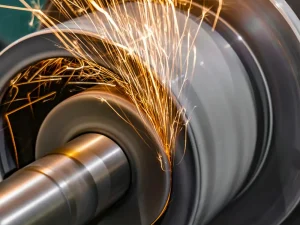
To achieve such an accurate, precise finish by grinding, specialized machines and equipment are used. So before you get started, let’s discuss the actual machines and equipment you will need for grinding.
- Main Grinding Machine: It is the main machine that performs grinding. This machine usually holds a grinding wheel and controls its movement.
- Grinding Wheel: The part that removes material from the workpiece surface. It is a wheel made of hard abrasive particles. These particles are like cutting tools.
- Chuck or Fixture: These tools hold the workpiece securely in place during grinding. They ensure the workpiece does not move while the wheel is working.
- Electric Motor: The motor powers the grinding machine. It helps the grinding wheel rotate at a very high speed, allowing material to be removed.
- Coolant System: The coolant system sprays a special liquid during grinding. This liquid reduces the friction-induced heat during grinding. It also directly protects the machine parts from overheating damage.
- Machine Table: It is the stable surface on which you place your workpiece. In most grinding machines, this table moves so that you can adjust the material accordingly.
How Does the Grinding Process Work? Step-by-Step
Grinding seems like a one-word process. However, in reality, it involves several steps that work together to produce the final product. If you are a beginner, you need to understand those steps carefully. So let’s discuss how to perform grinding and how it actually works, step by step.
Step 1: Select the Right Grinding Wheel & Set Up the Machine Settings
The very first thing you have to do is select the right wheel type based on your material’s nature. As you know, not every machining material has the same hardness, thickness, and size. Due to this difference, different grinding wheels are available. For instance, if you are grinding soft material like plastic, you should go for a wheel with fine grains. However, for hard materials such as metal and ceramic, choose a stronger, more abrasive wheel.
After you choose the wheel, fix it in the grinding position. Usually, you will see an arrow on the machine that indicates where to mount the wheel. But before that, make sure the wheel has no chips or cracks. Why? Because a slight crack can damage your product, as the wheel will rotate at a higher speed. Once you fix it, go to the machine settings. For example, set the wheel speed and grinding depth based on the material’s requirements.
Step 2: Mount the Workpiece & Adjust the Grinding Position
Now that your grinding wheel is fixed, the next step is mounting your workpiece. It is the actual material you want to grind to give it a finished look. So take it and mount it on the machine according to the manufacturer’s instructions, using a fixture. But make sure that it is tightly held and does not move.
A slight movement of the workpiece during grinding will highly affect its accuracy. Once the workpiece is fixed, the next job is to adjust its position. Here, you have to set the correct alignment between the grinding wheel and the workpiece. Make sure that both are in the right direction and at the right distance.
Step 3: Start the Grinding Machine & Feed The Workpiece
When you are sure that everything is aligned and fixed, turn on the grinding machine. However, don’t feed the workpiece immediately. Instead, let the machine run; the wheel must first rotate quickly before material removal. This will help the machine stabilize the wheel speed before it touches the workpiece.
Once you feel the wheel is rotating at the correct speed without issue, move the workpiece toward the wheel. This is known as feeding. In a manual grinding machine, you have to feed the workpiece yourself. Now there are machines that feed the workpiece automatically without the operator’s intervention. If you are doing this manually, be very careful. If the workpiece is pushed too quickly, it can damage the surface or create rough marks.
Step 4: Material Removal & Cooling Process
After feeding the workpiece, this is the step where actual grinding takes place. You will see that as the fast-moving grinding wheel touches the workpiece, the grains start removing the material. No doubt the wheel moves quickly, but the material is removed in a very controlled and precise amount. Each grain on the wheel is like a tiny cutting tool. However, during this removal, significant heat is generated by friction between the wheel and the workpiece.
If you ignore that heat, it will cause burn marks on the product or even damage the wheel. To prevent this, a coolant system works together with the grinding. When heat is generated, this system quickly sprays a special coolant onto that area. It will reduce heat and simultaneously wash away the chips produced during the removal process.
Step 5: Monitor & Inspect the Final Surface Finish
While grinding, you must also stay with the machine. Carefully watch everything and make sure that everything is going well. For example, the wheel is turning at the same speed, removal is happening properly, and no heat is accumulating. If you notice anything uneven, such as vibration, rough cutting, or unusual noise, stop the machine immediately.
After that, find the reasons and make necessary adjustments. Once grinding is complete and you have achieved the final results, turn off the machine. However, don’t immediately remove the material; let the wheel stop. Then remove the material and visually inspect it. Make sure the surface is smooth, clean, and polished, with no scratches or burn marks.
What Are the Main Grinding Processes Used in Industry? Types of Grinding
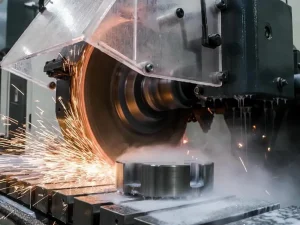
After understanding the actual grinding process, the next interesting part is that it is not a single process or method. Instead, industries use grinding techniques for different materials and designs. Let’s discuss some of the main grinding types and their specifications.
1- Surface Grinding
The first, basic grinding technique is surface grinding, which ensures the workpiece’s smoothness. In this method, the grinding wheel rotates and simply removes excess material, leaving it even. Usually, some parts look very smooth to the eye. But at the micro level, they contain unevenness that might cause problems while fitting. However, surface grinding removes those imperfections with precision and ensures tight tolerance. However, this method is not meant for complex shaping or heavy cutting. It just makes the material’s surface smooth and clear.
2- Cylindrical Grinding
Cylindrical grinding is another process used for cylindrical objects, such as shafts, rods, pipes, and rollers. Like any flat surface, these cylindrical parts also sometimes have imperfections. If not removed, the round machine part can show uneven performance and vibration. Normal grinding might not remove that unevenness. That’s why cylindrical grinding is used to make the outer surfaces of these round parts smooth and accurate. Here, the workpiece rotates while the grinding wheel also spins at high speed. They move together, grinding begins and removes material from all around the workpiece.
3- Centerless Grinding
Centerless grinding is a specialized grinding process. It is used to produce a finish on complex round and cylindrical shapes. Some complex cylindrical shapes cannot be made smooth with regular cylindrical grinding. For this, centerless grinding is used. It differs because, in this process, the workpiece is not held between centers or tightly fixed in a chuck. Instead, it is supported between two rotating wheels. The job of one wheel here is to perform grinding, such as removing the material. However, the second wheel controls the speed and movement of the rotating workpiece. Because the part does not need to be fixed and removed repeatedly, centerless grinding is much faster.
4- Internal Grinding
Another grinding type you will find is internal grinding, which smooths and finishes the inside surface of holes and tubes. When other machining processes make holes, they often contain incorrect dimensions. Now these holes cannot hold the bolts or nuts accurately. So it is internal grinding that helps make these holes smooth. Like other grinding methods, it does not remove material from outside but from the inside of the workpiece. For this, a very small grinding wheel is chosen that can fit into even a small hole. That wheel rotates inside the hole, starting to grind and smooth the surface.
5- Creep Feed Grinding
Creep-feed grinding is large-scale grinding that removes substantial material from the workpiece. In the regular process, you see that the grinding wheel removes very little material. But in this case, the wheel cuts deeper into the material and removes a large amount in one pass. The movement of this process is slow to ensure an even surface. Due to this long contact, a lot of heat is generated. To control heat, coolant is continuously used during grinding.
6- Profile Grinding
Profile grinding is a type of grinding that makes special shapes and detailed designs on a material. Normally, in grinding, wheels remove a small amount of material just to make the surface even and smooth. But in this grinding, wheels not only remove material but also create features such as curves, grooves, and sharp edges. The main working is similar: the wheel removes material, but according to the given design. Often, for this grinding, CNC-based machines are used that create exact, detailed features according to the design. That’s why there’s no chance of error.
7- Form Grinding
Lastly, there is form grinding, which uses a special type of grinding wheel that contains a specific design on its surface. When this designed wheel runs on the workpiece surface, it transfers that shape onto the material. Unlike profile grinding, which creates the design slowly, form grinding is very efficient and fast. The wheel already has a design on its surface, so it just needs to transfer that design in no time. However, form grinding is good only when you need an identical design. For variety, you have to go with many wheels, which might increase the overall cost of the process.
Advantages & Disadvantages of Grinding
Grinding is one of the most useful processes in modern manufacturing. But like any method, it has both strengths and limitations. Before you get started, let’s discuss the pros and cons of grinding.
Advantages
- Smooth Surface Finish: Grinding is primarily about imparting smoothness to a surface. The grinding wheel removes very small amounts of material very slowly. As a result, the final surface becomes clean, even, and free of rough marks.
- High Accuracy and Precision: Grinding can also produce very accurate shapes and sizes, as well as a smooth finish. It can control material removal in very small amounts. This helps you achieve the exact size, thickness, and shape of the material.
- Works on Hard Materials: Another advantage of grinding is its versatility. It is not just for soft materials; it also handles hard materials like steel, brass and more. Some alloys are difficult to cut with standard tools, but they can be ground.
- Improves Product Performance: Some machine parts require very tight tolerances. A slight misalignment can affect their performance. But grinding removes those imperfections, making the critical part fit perfectly.
Disadvantages
- Slow Material Removal: One major disadvantage of grinding is that it removes material very slowly. The grinding wheel removes only a small amount of material at a time. This makes it unsuitable when a large quantity of material needs to be removed quickly
- Heat Generation: Grinding is essentially a rubbing process. That’s why it generates a lot of heat from continuous friction. If this heat is not controlled, it can cause burns, cracks, or changes in the material properties.
- Wheel Wear: The wheel remains constantly in contact with hard materials. Therefore, it wears out over time, reducing its cutting ability and failing to provide surface finishing. In many cases, you have to replace that wheel.
- Higher Cost: Lastly, grinding is more expensive compared to other machining methods. The reason lies in advanced grinding machines, which cost more. In addition, the extra coolant systems and regular maintenance further enhance its upfront cost.
What Industries Use Grinding the Most? Applications
Grinding is the most efficient process for achieving a smooth, precise finish on various materials. Due to this range of advantages, it has become a necessity for several industries. So let’s look at the main industries that heavily rely on grinding.
| Industry | Use of Grinding |
| Automotive | Engine parts, gears, shafts |
| Aerospace | Aircraft and turbine parts |
| Tool & Die | Tools, molds, and dies |
| Manufacturing | Machine parts finishing |
| Construction | Metal parts and pipes |
| Medical | Surgical tools |
| Metal Fabrication | Shaping and finishing metal |
Frequently Asked Questions
Can All Grinding Operations Be Automated?
Not all grinding operations can be fully automated. Only simple, high-volume tasks can be automated with CNC grinding machines.
Do Grinding Machines Always Improve Production Accuracy?
Yes, grinding machines usually improve accuracy, but only when they are used correctly. If you choose the wrong wheel or don’t set the right machine settings, the results will be inaccurate.
Can Grinding Machines Be Used on Hard Metals Like Steel?
Yes, grinding machines are very effective on hard metals like steel. In fact, grinding is one of the best methods for finishing hardened materials that are difficult to cut with normal tools.
Conclusion
Grinding is one of the most efficient processes that makes materials smooth, accurate, and ready for use. It uses an abrasive wheel that removes a very small amount of material from the workpiece, leaving it smooth. The process is known for its higher accuracy and precision. But it is not operated in one single way. Instead, several techniques shape and give the material a finish in different ways. But beyond all this, grinding also comes with limitations, such as frequent wheel wear and a higher upfront cost. That’s why, before you choose it, know all its types, pros, and cons for more effective results.