
 Deutsch
 Français
 日本語
 Español
 Italiano
 Русский
 繁體中文
 한국어

Aluminum is an important part of several products we use and see every day. One reason it is so popular is that it is light, durable, and easy to shape into various forms. However, aluminum is not just one material, but comes in several alloy forms. Two of those common alloys are aluminum 6061 and aluminum 7075. But when it comes to choosing between these alloys, the question arises: aluminum 7075 vs 6061. Which truly stands out?
At first, these two aluminum alloys seem similar in appearance. However, in reality, there are huge differences that set them apart. These differences are what affect the final choice. That’s why understanding them is very crucial, no matter what project you are choosing. But if you feel confused, worry not! In this guide, I will compare 7075 and 6061 aluminum head-to-head. So let’s get started.
Aluminum 7075 vs 6061: 10 Key Differences
No doubt, both 7075 and 6061 are aluminum alloys. Also, they share several similarities. However, there are several other aspects in which the two vary widely. For better understanding, let’s discuss the main factors that distinguish aluminum 7075 and 6061.
1- Chemical Composition & Hardness

The first major difference between aluminum 7075 and 6061 lies in the alloying elements used to make them. Aluminum 6061 generally contains magnesium and silicon as major components. Along with these materials, there are small amounts of manganese, iron, and other alloying elements.
On the flip side, aluminum 7075 has a much higher zinc content, along with smaller amounts of magnesium and copper. These materials are what give it more hardness. Greater hardness allows 7075 aluminum to withstand dents, scratches, and surface wear. However, 6061 aluminum is not much harder, and that does not make it a poor choice. It might not resist wear very well, but the lower hardness still makes it easier to cut and shape.
2- Strength & Durability
When it comes to strength, aluminum 7075 is the clear winner. Why? The first major reason is its chemical composition, which contains zinc. It can handle much heavier loads and higher stress without the risk of bending or breaking. That’s why it is sometimes compared to certain grades of steel.
This strength also allows it to last longer, enhancing its lifespan even in challenging environments. In contrast, aluminum 6061 is also durable and strong but for everyday applications. However, as I said above, it is not harder, so dents can affect its surface. That’s why, for conditions that require handling extremely heavy loads, 6061 might not work well. In such environments, its durability also decreases.
3- Weight & Ease of Handling
You might know that aluminum is known for its lightweight. So, truly speaking, both aluminum 7075 and 6061 are lighter than many other metals. However, in their deep comparison, there is a slight difference in their weight and density. For example, aluminum 6061 has a density of about 2.70 g/cm³.
This makes it lighter and easier to work with and handle. You can transport it long distances without any difficulty. On the other hand, aluminum 7075 has a slightly higher density of about 2.81 g/cm³. This is a very slight difference, but it affects many projects, such as aerospace projects. This higher density also makes it heavier, which ultimately doesn’t make it much easier to handle. Special handling in transportation is required for this alloy.
4- Corrosion Resistance & Fatigue Resistance
Corrosion and fatigue resistance are another area in which both aluminum alloys differ a lot. If we discuss aluminum 7075, it is corrosion-resistant but to a limited extent. Its higher amount of zinc and copper makes it more likely to corrode. When you use it continuously in a salty environment, its upper layer begins to deteriorate. That’s why manufacturers often protect it with anodizing and painting. But when it comes to fatigue resistance, the situation is the opposite.
Now, aluminum 7075 has an excellent ability to withstand repeated loading and unloading. It does not develop wear or scratches easily due to its higher hardness. In contrast, aluminum 6061 is much more resistant to corrosion. The reason lies in its higher content of magnesium and silicon, which help it withstand a moist, salty environment. But in terms of fatigue resistance, it might perform well due to its lower density and softness. Heavy loads and continuous stress often cause dents and surface scratches.
5- Weldability & Machinability
Weldability refers to how easily two pieces of metal can be joined by welding. In this regard, aluminum 7075 is highly compromised. This is because of its hardness and higher zinc content. When you try to weld it, the risk of cracks increases. Also, welding weakens the metal around the welded area. That’s why manufacturers avoid welding 7075 aluminum. If necessary, they must use specialized welding techniques that are much more expensive. However, for machinability, 7075 aluminum is a much better choice.
Its higher hardness allows it to produce clean, accurate cuts with less tool wear during CNC machining. On the other hand, 6061 aluminum is much easier to weld than 7075. It has a lower density and a good amount of magnesium and silicon. This material helps it remain stable during welding and does not crack or weaken the surrounding area. The joint stays strong for a long time after welding. However, it is not a good choice for CNC machining. But for regular fabrication, it is much easier to cut and shape.
6- Heat Treatment
Heat treatment is a process in which the hardness and strength of a metal are improved. Heat changes the metal’s internal structure, making it stronger and more durable. Both aluminum 7075 and 6061 can be heat treated, but they respond differently. For example, aluminum 6061 gains a moderate increase in strength after heat treatment.
It still retains its key properties, such as good corrosion resistance and ease of welding. Aluminum 7075, however, benefits much more from heat treatment. How? Actually, after heat treatment, it becomes much stronger and harder than 6061. This hardness makes it more useful for stress-bearing applications. The trade-off is that, even after heat treatment, it remains more difficult to weld.
7- Thermal Conductivity
Thermal conductivity is a material’s ability to move heat from one place to another. Right? Each of these aluminum alloys has a different level of thermal conductivity. If you look at 7075 aluminum, it contains much higher amounts of zinc and copper. These alloying elements are added to increase its strength and hardness.
But at the same time, these elements make it harder for heat to flow through the metal. 7075 has lower thermal conductivity. Conversely, aluminum 6061 has much better thermal conductivity than 7075. Why? Because it contains more pure aluminum (about 95.8-98.6%) and less copper and zinc. Now, pure aluminum allows heat to flow freely from one end to the other with less hindrance. That’s why it is favored for making cooking appliances.
8- Electrical Conductivity
How easily a metal allows the current to flow is the electrical conductivity. Compared with aluminum 7075, aluminum 6061 has better electrical conductivity. The main reason is that 6061 contains a higher percentage of pure aluminum. Like heat, pure aluminum also makes it easier for current to flow without generating heat.
On the flip side, aluminum 7075 contains larger amounts of zinc, copper, and magnesium. These elements make it harder and stronger but also interrupt the smooth flow of electric current. This hindrance builds up heat and makes aluminum 7075 a poor conductor of electricity. That’s why it is not favored for wiring or electrical equipment.
9- Best Use Cases & Common Applications
Now you can see there are several variations between both 7075 aluminum and 6061. This variation also makes their usability different across different industries. For example, 7075 aluminum is primarily used in applications where strength is the top priority. That’s why you can find it in.
- Aircraft structures and aerospace components
- Military equipment
- High-performance bicycle parts
- Racing car components
- Climbing and mountaineering equipment
- Precision molds and tooling
- High-stress machine parts
- Firearm components
On the other hand, aluminum 6061 is used for applications that demand lightweight and corrosion resistance. That’s why it is used.
- Building structures and construction projects
- Bridges and walkways
- Pipelines and storage tanks
- Marine equipment and boat parts
- Automotive parts
- Bicycle frames
- Machine frames and components
10- Cost & Affordability
Lastly, cost is a major factor to consider when comparing the two aluminum alloys. Cost mainly varies with the properties. So, aluminum 6061 is generally more affordable. Several reasons explain this. First of all, it is a widely produced alloy, which makes it easier to find in different sizes and shapes. Secondly, it is very easy to cut and shape. There is no need for expensive tools for fabrication and machining, which reduces its manufacturing costs.
However, 7075 is usually more expensive. It contains higher levels of alloying elements such as zinc, magnesium, and copper. Both of these increase its performance but also its production cost. Its welding requires special techniques that are much more expensive. Also, it needs more careful manufacturing and heat treatment to achieve its exceptional strength.
Aluminum 7075 vs 6061: Which One Should You Choose?
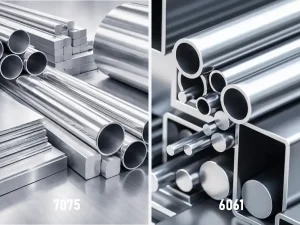
There is no single best choice between aluminum 7075 and 6061. Instead, it depends on what your project needs.
If you want an aluminum alloy that is easy to weld, resists corrosion, is simple to machine, and is more affordable, Aluminum 6061 is the better option. If your project needs the highest strength, hardness, and fatigue resistance, Aluminum 7075 is the better choice.
So, from the differences, all the weaknesses and strengths of both aluminum alloys are clear to you. Right? Now it has become much easier to choose the one that matches your project needs. For example, aluminum 6061 is a great all-around material. You can choose it for a good balance of strength, durability, corrosion resistance, and workability. At the same time, it is a very affordable and good machining material.
However, its compromised strength and hardness might limit its use for some applications. On the flip side, aluminum 7075 is a favorable choice for its strength, durability, and high performance. However, in terms of weldability and machinability, it is slightly compromised. Also, these extra qualities make it expensive, which sometimes justifies its use in high-end projects. So keep all the pros, cons, and other aspects in mind, and choose the most reliable one.
Conclusion
Aluminum is one of the most widely used materials around us. It comes in many forms, but two of its alloys, 7075 and 6061 aluminum, are the most famous. Many beginners consider them alike due to their similar appearance. But in reality, they differ significantly in many respects that I have discussed in this guide. Aluminum 6061 is a practical and reliable option. It offers a great balance of strength, durability, corrosion resistance, and easy fabrication. Aluminum 7075 is the preferred choice for applications where maximum strength is a priority. So the best choice depends on what your project needs most.