
 Deutsch
 Français
 日本語
 Español
 Italiano
 Русский
 繁體中文
 한국어

In the past, manufacturing machines were not automated and precise. However, things changed over time due to the introduction of CNC-based machines. These machines are precise because the G-code they receive is precise. However, what is G-code, and what is its role in modern machining?
Interestingly, G-code is a programming language that gives instructions to the machines. Without these instructions, the machines cannot work properly. These instructions include how the machine’s cutting tools will move or cut the workpiece. In this article, I will explain everything about G-code, including its structure, types, and functions. Let’s get started.
What is G-code?

G-code is a programming language used in CNC machines. This language enables machines to understand their role, resulting in greater precision. G-code is generated by CAM software and fed to machines before they run. This G-code includes detailed instructions for cutting tools and machines for working.
These G-codes tell the machine about how fast the cutter should move. It also tells the path, coordinates, and direction so that machines work with precision. As I said above, machines in the past were manual and less precise. However, modern machines are automated, efficient, and precise primarily due to their G-codes.
G-code consists of two primary components. These include command lines and command parameters. The example of command lines in G-code is as follows:
G01 X50 Y25 F100
The machines understand this G-code command line and perform specific tasks. However, the command parameters provide more detailed insight from this line. For G01, X50, Y25, and F100 are four different command parameters. Each of these gives different instructions to the machines. G01 indicates that the machine should use linear movement.
X50 and Y25 indicate the coordinates to which the cutting tool should move. The CNC-based machines become precise when they know:
- What to do?
- Which speed cutting tools should move?
- In which direction and coordinate cutting tools should move?
G-codes provide this information to the CNC-based machines through their command lines. As a result, the machine’s precision reaches a new level. Remember, G-code is generated after a design is created in CAD software. This design is then converted into G-code through CAM software. G-code helps convert digital designs into physical products using machines.
What is a G-code Command?
As I said above, G-code and G-code commands are two different things. G-code is a set of instructions that machines follow to perform their actions. However, G-code commands a specific task inside the G-code. This command instructs the machine about the movement and cutting paths (positioning). Below is the list showing different G-code commands and their meanings:
| G-code Command | Meaning |
| G00 | Rapid move (no cutting) |
| G01 | Linear cutting move |
| G02 | Clockwise arc movement |
| G03 | Counterclockwise arc movement |
| G20 | Units in inches |
| G21 | Units in millimeters |
| G28 | Return to home position |
| G90 | Absolute positioning |
| G91 | Incremental positioning |
| G92 | Set current position |
| M03 | Start spindle (clockwise) |
| M04 | Start spindle (counterclockwise) |
| M05 | Stop spindle |
| M06 | Tool change |
| M30 | End program |
How Does G-code Work?
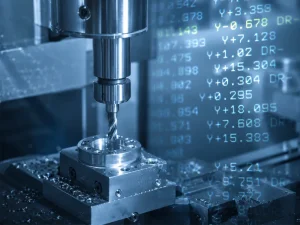
G-code operation begins with creating a digital design in CAD software. An expert CAD designer makes this CAD design to ensure precision. Even small mistakes in the CAD design can make the entire production process less efficient and less precise. The reason is that the final product will be identical to the design you created in CAD software.
Once the CAD design is complete, you’ll need to convert the digital CAD design into G-code instructions. For this, you’ll have to use CAM (Computer-Aided Manufacturing) software. After this, your CAD design will be converted into a G-code file containing blocks (command lines and parameters). These command lines provide exact instructions for modern machines.
These command lines provide different instructions to the machines. These include moving the tool, coordinates (X, Y, or Z axes), cutting material, or changing speed, and so on. The machines carefully execute the G-code lines in the right sequence to ensure smooth operations. Suppose there are G-code lines such as:
G01 X25 Y50 F100
This code tells machines to move the cutting tools in linear movements. After that, the tool should be 25 units to the X axis (left and right). Y50 indicates that the tool should move its cutter 50 units in the Y axis (Forward and backward). This way, machines understand the exact action to execute and make the final product with precision.
Types of G-Code
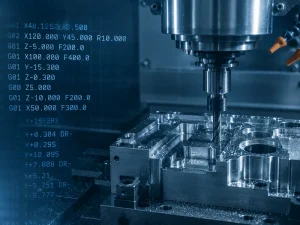
Interestingly, there are various types of G-codes. Each type plays a specific role in the functionality and performance of CNC-based machines. In the next section, I will explain the basics of each G-code type.
1- Motion (Movement) G-Codes
Motion G-codes instruct the machines about the movement of cutting tools. Without these motion G-codes, the machines won’t know how to move the cutters. The examples of motion G-codes include G00, G01, G02, and G03. Each of these motion G-codes provides different instructions for these cuttings. G00 indicates rapid movement, while G01 tells the machine to perform linear motion. Similarly, G02 and G03 tell machines to move the cutting tools in clockwise and anticlockwise movement of the cutting tools.
2- Positioning G-Codes
Positioning G-code is another important type of G-code. It guides CNC machines in the precise positioning of cutters (cutting tools). As you know, when CNC machines work, their cutting tools move in space (different coordinates) to fabricate the workpiece. Positioning G-codes guide the positioning of these tools in X, Y, and Z coordinates. Examples of positioning G-codes include G90, G91, and G92.
3- Unit Setting G-Codes
As I said earlier, different measurements are used to guide machines for precise operations. Small mistakes can cause the machines to cut the wrong size. There are two popular units used to tell the exact dimensions of different parameters. These include inches and millimeters. For CNC machines, it is important to mention whether dimensions are in inches or millimeters to prevent confusion. In this unit setting, G-codes G20 and G21 are used. If the code includes G20, the measurements will be in inches. On the other hand, G21 indicates measurements in millimeters.
4- Machine Control G-Codes
Machine control G-codes have nothing to do with the paths or direction of cutting tools. Instead, they only refer to the operation of the machines and their control. For example, G28 means the machine will return to its default position. The cutting tools, regardless of their position, will return to their zero or reference points with G28. Similarly, some other machine control G-codes include G17, G18, G19, and more. In the section below, I am mentioning a table to show different machine control G-codes:
| Machine Control G-code | Meaning |
| G28 | Return to home position |
| G54 | Work coordinate system 1 |
| G55 | Work coordinate system 2 |
| G56 | Work coordinate system 3 |
| G57 | Work coordinate system 4 |
| G17 | Select XY plane |
| G18 | Select XZ plane |
| G19 | Select YZ plane |
| G53 | Move in machine coordinate system |
5- Tool Compensation G-Codes
Tool compensation G-code is important to improve the precision and accuracy of machining. Simply put, they ensure the parts made have a smooth finish. These G-codes ensure that machines compensate when the cutting tool’s thickness or diameter is different. Some of the tool compensation G-codes include G40, G41, and G42.
The meaning of G41 is that the machine compensates on the left side of the cutting tools. On the other hand, G42 refers to the compensation on the right side of the tool. This way, a higher or lower thickness of cutting tools, or their unsuitable diameters, does not affect the precision of machining. If there is G40, this means there is no need for tools compensation from the CNC machines.
Function or Importance of G-Codes
G-code is important for modern manufacturing machines. The reason is that this coded instruction guides the CNC machines on how to work. In other words, G-codes tell CNC machines about the following parameters:
- How to move
- Where to move
- What to do (action to perform?
- How fast should cutting tools move
- A guide about direction and the tool path
After receiving all these instructions and guidance, the CNC machine’s precision reaches a new level. Why? The reason is that the machine’s cutting tools move to the correct dimensions. They make precise cuts with exceptional surface finishing. Additionally, the cutting tools can move along different axes and planes to make even very complex-shaped parts.
In short, the function of G-codes is to make CNC machines work, that too with precision. If there were no G-code, the machines’ automation level would have been affected. So they had to cut manually, which would require more manual effort and result in more errors. Remember, with G-code, you get the final products that are precisely the same as the CAD file you made in the first step. This level of precision is possible only because the G-code is fed to the CNC machines.
Uses or Applications of G-code
The use of G-code has become essential in almost all modern machines. Why? The reason is that their presence makes machines precise, automated, and very fast. This is one of the major reasons G-code is a must for CNC machining. Apart from this, this G-code is also used in modern 3D printers.
In printers, the CAD design of the desired part is made and then converted to G-code. After this, G-code is fed to the 3D printer. The printer then follows the instructions and makes different parts or products layer by layer. Manufacturers use these modern machines to make parts where precision is of utmost importance.
Below is the table that indicates different machines that use G-code:
- CNC Milling Machines
- CNC Turning (Lathe) Machines
- CNC Drilling Machines
- CNC Grinding Machines
- 3D Printers (FDM/FFF type)
- Laser Cutting Machines
- Laser Engraving Machines
- Plasma Cutting Machines
- EDM (Electrical Discharge Machines)
- Waterjet Cutting Machines
- CNC-based welding machines
Frequently Asked Questions
What are the functions of G-code?
The fundamental function of G-code is to guide the CNC machines on how to act. These codes provide instructions for machines on how to move, what to do, and at what speed to operate. This instruction enables machines to work quickly and with excellent precision.
Is G-code a programming language?
Yes. G-code is actually a programming language. It consists of different blocks, commanding lines, and parameters. These parameters instruct CNC-based machines on how to cut to produce desired-shaped parts.
Do I need to write G-code manually?
No. G-code is typically generated through CAM software. You create a CAD model of your desired part and then convert it to G-code using software. There is no need to write the G-coded manual, which can be very tiresome.
How does a CNC machine read G-code?
As discussed above, G-code consists of command lines and parameters. The machines are designed to read these lines sequentially. They understand each line, execute the action, and move to the next line. This way, these machines make the final parts with accuracy.
Is G-code hard to learn?
No. G-code consists of a few specific rules and patterns. Understanding G-code is not particularly challenging. You can learn G-code in a few weeks if you pay attention and have the will to learn. However, it can take longer to become an expert in G-code, which is possible through experience and training.
Conclusion
Let’s conclude – G-code is one of the most helpful inventions done in the modern era. This code is generated from a digital CAD model. It consists of specific rules, patterns, and instructions that are handy for operating machines. The CNC-based machines follow these computerized instructions and perform specific actions.
As a result of these instructions, the machines perform in an automated and precise way. Above, modern machines using G-codes operate at high speed, which is a significant advantage. There are different types of G-code that provide different information to CNC machines. In this article, I have discussed everything about G-code, including its functions and its importance.