
 Deutsch
 Français
 日本語
 Español
 Italiano
 Русский
 繁體中文
 한국어

Copper is a very popular material being used worldwide. Its most prominent use is in the electrical wires used in our homes. However, copper’s density enhances its practical importance. But the question is: What is the density of copper? I know the density term may sound similar to weight, but it is quite different.
Density indicates how much space a material takes or occupies. In simple words, it is the weight that you can accommodate per unit volume. Knowing the density of copper is essential if you want to get the most out of this material. In this article, I’ll explain everything about copper’s density. In the end, you’ll know whether copper is suitable for your machining project.
Overview of Density

Before going to discuss copper, let’s understand what density means. Density differs from weight, as it indicates the space a material occupies.
It is the measurement of how tightly packed the atoms of a material are in its structure. In scientific definition, density is mass in specific volume (per unit volume). You can consider the mass of the object (material) in a particular space or place. It does not indicate only weight; instead, it’s the weight that fits in a specific space (volume).
The material with higher density has atoms more tightly packed in its structure. On the other hand, material with lower density has atoms that are more loosely packed. Interestingly, two materials can have the same weight but differ in terms of density. For example, you have 100 grams of copper and 100 grams of aluminum. Both of these materials you have consist of the same weight. Right?
However, their density will still differ. The densities of copper and aluminum are 8.96 g/cm³ and 2.70 g/cm 3, respectively. The unit of density is grams per cubic centimeter (g/cm³). You’ll also see this unit written in kilograms per cubic meter or pounds per cubic inch. All of these units have the same meaning, and you can use grams per cubic centimeter (g/cm³) as the most common standard unit worldwide.
It is noteworthy that density can be calculated using a specific formula.
Density = Mass / Volume
By putting the value of mass and volume, you can find the density of every material. The material with higher density is considered more durable and stronger. Why? Its parts are tightly packed together, offering better resistance to shocks and impacts. On the other hand, less dense materials are weak and are not considered for most of the machining tasks.
What is the Density of Copper?
The density of copper is 8.96 g/cm³ (grams per cubic centimeter). It means you can fit 8.96 grams of copper in one unit volume (space). Different types of coppers are available, and their densities can vary. However, 8.96 g/cm³ is widely accepted as the density of copper.
Remember, grams per cubic centimeter is the most common unit for measuring copper density.
However, you’ll also see people using other units to express copper density. All of those units have the same meaning, and you can convert them into cubic centimeters. Here is a table showing the density of copper in different measurement units:
| Measurement Unit | Density of Copper |
| Grams per cubic centimeter (g/cm³) | 8.96 g/cm³ |
| Kilograms per cubic meter (kg/m³) | 8,960 kg/m³ |
| Pounds per cubic inch (lb/in³) | 0.323 lb/in³ |
| Pounds per cubic foot (lb/ft³) | 559 lb/ft³ |
This copper density is generally considered on the higher side. It means that atoms in the copper are tightly packed or held together. They are not loose, and make copper excellently strong and rigid. As I said earlier, if atoms are closely packed, the material performs better and is considered stronger.
As a result, you’ll use copper in machining. The density of copper in pure form generally varies from that of copper with impurities. 8.96 g/cm³ is the density of copper in the pure form. Its density can increase or decrease depending on the type of impurity present. If an impurity with higher density is added, it increases copper’s density too, and vice versa.
Different Copper Types & their Densities

As I said earlier, there are different types of copper with different compositions. Pure copper is not ideal for some uses. Therefore, manufacturers add alloying elements to impart the desired properties to copper. However, the addition of this alloy element influences the density and other properties of the copper. For example, pure copper has a density of 8.96 g/cm³.
On the flip side, Beryllium copper has reduced density (around 8.25g/cm³). This is due to the presence of an alloy element (beryllium). The higher the beryllium content, the lower the density, and vice versa. Here is a table showing different types of copper and their respective densities:
| Copper Type / Alloy | Typical Composition | Density (g/cm³) |
| Pure Copper (Cu) | 99.9% Copper | 8.96 |
| Beryllium Copper | Cu with 0.5–3% Beryllium | 8.25 – 8.4 |
| Aluminum Bronze | Cu with Aluminum | 7.6 – 8.4 |
| Silicon Bronze | Cu with 2–4% Silicon | 8.2 – 8.8 |
| Yellow Brass | 60% Cu, 40% Zn | 8.4 – 8.6 |
| Cartridge Brass | 70% Cu, 30% Zn | 8.5 |
| Muntz Metal | 60% Cu, 40% Zn | 8.5 |
| Monel | 63% Nickel, 28–34% Copper | 8.8 |
In some copper alloys, I mentioned a range of densities in the table. Why? The reason is that their density varies with the amount of alloying elements. Suppose beryllium copper has a density around 8.25 – 8.4. If the proportion of beryllium is higher, it would reduce the density of beryllium copper and vice versa. Why? Because beryllium has a low density of around 1.85 g/cm³.
On the other hand, copper has a higher density. If beryllium is present in greater quantity, it would reduce the density of beryllium copper. Similarly, if the beryllium is very low in quantity and the copper is in higher amounts, the beryllium-copper would have a high density. The density of alloy elements or impurities will alter the density of copper.
Why Does Copper have a Higher Density?
As I said earlier, copper has a higher density (8.96g/cm³) than many other materials. For example, stainless steel, nickel, titanium, zinc, and many other elements are low-density. Are you wondering why copper has a higher density?
The higher density is due to the FCC (face-centered cubic) structure. In this structure, the atoms of the materials are presented very close together. In simple terms, they remain packed together, leaving little or no gaps between them. If those atoms are so packed, they occupy less space.
In simple words, more atoms will be accommodated in less space. Each atom of copper has an atomic mass of 63.5. When more atoms are packed together, they have more atomic mass. Right? When the atomic mass is higher, the density will be higher, and vice versa. Here is a formula to find the density of copper:
Density = Mass / Volume
In simplest words, the copper atoms are very closely packed together. As a result, they occupy less space and more often come in that less space. Those materials whose atoms are loosely bound in structure have low density. Why? Because they will need more space to accommodate distant or loosely bound atoms. The lack of gaps between copper atoms results in a higher density.
Factors that Affect Copper’s Density
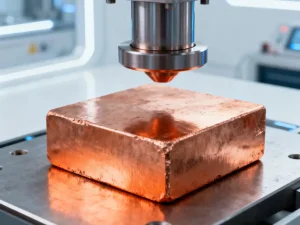
As I said earlier, copper density can vary depending on various factors. In the section below, I will discuss some of those factors related to copper’s density.
1- Pressure or Stress
Pressure and density are directly related regardless of materials. Why? When pressure is applied, the material’s atoms come closer together. This results in strong atomic packing in the material. More atoms remain confined together, occupying less space. So, the density increases. This is the same for the density of copper materials. More pressure will bring the copper atoms closer together, increasing the copper’s density.
2- Temperature & Heat
The temperature is inversely related to the density of copper. How? When you heat copper, its atoms that were close together start to move randomly. This creates a gap between copper atoms, allowing them to occupy more space. As a result, the copper density decreases with increasing temperature. Remember, dense material has the atoms close together. But as temperatures rise, the atoms move farther apart, resulting in lower density.
3- Purity of Copper
As I said earlier, sometimes copper contains impurities. Right? Those impurities are present in very small amounts, but they can still affect copper’s density. The density of copper depends on the type of impurity. For example, if impurity has a higher density than copper, it would increase the density of copper as well. On the flip side, if it has a lower density than pure copper, it would reduce the density of copper.
4- Alloy Elements
Have you noticed that pure copper and its alloys have different densities? The reason is that the presence of alloy elements affects density. The best example is beryllium copper. As I mentioned earlier, pure copper has a density of 8.96 g/cm³. However, beryllium copper (alloy) has a density range of 8.25–8.40 g/cm³. The reason is that beryllium has a lower density (1.85 g/cm 3), which affects the density of the overall combination (copper alloy).
5- Sudden Change or Defect in the Structure of Copper
As I said earlier, the copper structure is the primary reason for its higher density. It has an FCC (face-centered cubic) structure, and all atoms are tightly bound. If this structure is disturbed, it can affect the copper’s density. Imagine if copper undergoes an impact that alters its structure. As a result, the arrangement of atoms will be disturbed. As a result, they produce a gap between the atoms. So, the same copper atoms won’t be packed together, leaving more space. As a result, the copper density will decrease.
Comparing Copper’s Density to Other CNC Materials
The density of copper is generally considered higher. Many materials used in CNC machining have a lower density. Remember, lower density means material is less strong, and vice versa. As a result, copper is more valuable because it has a higher density (8.93) and is stronger. What makes copper stand out is its ductility.
It means this material (copper) can be used to make wires, and other such parts and products. It is also noteworthy that copper density is not the highest among the CNC machining materials. There are many other materials with densities higher than that of copper. Here is the table showing the density of different materials:
| Material | Density (g/cm³) | Comparison to Copper (8.96 g/cm³) |
| Magnesium | 1.74 | Much lower density |
| Aluminum | 2.70 | Lower density |
| Titanium | 4.51 | Moderate density |
| Beryllium Copper | Around 8.25 | Slightly lower density |
| Brass | Around 8.50 | Close to copper’s density |
| Copper (Pure) | 8.96 | Reference value |
| Bronze | Around 8.80 | Nearly equal density |
| Lead | 11.34 | Higher density |
| Tungsten | 19.25 | Much higher density |
| Gold | 19.30 | Much higher density |
Why Density Matters in CNC Machining?
Interestingly, the material density (copper) plays a key role in CNC machining. If a material has a higher density, its CNC machining is generally more challenging. Why? Higher density means the material is more robust. So, cutting tools of the machines require more power to cut that material. When the cutter cuts the higher-density material, it generally wears out quickly.
Additionally, cutting and shaping material with higher density slows the machining process. However, the parts made with high-density materials are robust and last longer. This is why manufacturers generally prefer high-density CNC materials. Are you wondering about CNC machining of copper?
Copper has a mid-range density – not too low, not too high. This makes copper excellent for both machinability and strength. The CNC machining can easily cut copper, and the cutting tools don’t wear out. Additionally, the CNC-machined copper parts are very durable. Their performance is far better than that of parts made from lower-density materials.
Frequently Asked Questions
What is the density of copper in kg/m³?
The density of copper is 8,960 kg/m³. Remember, kg/m³ refers to kilograms per cubic meter. In some countries, you’ll see this measurement unit used instead of g/cm³.
What is the density of copper in pounds?
The density of copper in pounds is 0.323 lb/in³. This lb/in³ indicates the measurement unit of pounds per cubic inch. This unit is generally used in countries where the imperial unit system is preferred.
Is copper a heavy metal?
Yes, copper is considered a heavy metal, with a density of 8.96 g/cm³. This higher density ensures greater weight, but also provides excellent strength and durability. However, it is non-toxic, which makes this metal stand out.
Conclusion
Copper is a very popular material for CNC machining. Its ease of cutting, despite its higher density, makes it stand out. However, many people have no idea about the density of copper. In this article, I’ve discussed everything about the copper density, including factors that affect it. You should keep in mind that the density of pure and impure copper varies from each other. If you understand this article, you’ll no longer have unanswered questions about copper density.