
 Deutsch
 Français
 日本語
 Español
 Italiano
 Русский
 繁體中文
 한국어

Various metals are machined to produce a range of products. Manufacturers use advanced machines to fabricate these materials. Among those materials, bronze is very popular due to its excellent machinability. In fact, almost all the modern manufacturers offer bronze machining services to their customers.
The main reason for this copper-based alloy’s popularity is its excellent properties. Despite being very robust, this material can be cut, shaped, and drilled easily. So the cutting tools don’t need to apply more force, which could cause overheating. In this article, I’ll explore bronze machining, its benefits, and the techniques used. So, let’s get started!
Overview of Bronze and Its Machining

Let’s start with the basics of bronze and its machining. Understanding this will help you know how this material is so useful in different sectors.
Bronze is an alloy consisting mainly of copper and tin. Apart from these two, this alloy also contains other elements, such as silicon and aluminium. The presence of tin, silicon, and aluminium gives this material excellent strength and durability. One of the standout features of bronze is its resistance to corrosion and rusting, even in harsh conditions.
Here is the chemical composition of the bronze:
| Alloying Element | Typical Proportion |
| Copper | 85–95% |
| Tin | 5–12% |
| Aluminum | 5–11% |
| Silicon | 1–4% |
| Lead | 2–8% |
Bronze, a copper-based alloy, has a high amount of copper. When copper reacts with oxygen, it forms an oxide layer on its surface. This layer protects the alloy from corrosion, and the presence of tin further strengthens it. As a result, bronze performs excellently in moist conditions where other materials corrode.
Additionally, this material does not rust because it contains no iron, which is responsible for rust. These properties make bronze an ideal option for machining parts for use in moist conditions. Wondering what bronze machining is?
Bronze machining involves using dedicated machines to cut, shape, and drill the bronze. These machines can include a milling machine, a lathe, a grinder, and more. Each of these machines cuts bronze differently and produces complex-shaped parts. The ease of fabrication and the softer nature make machining bronze much easier.
This machining is common across various industries. These include automotive, aerospace, electronics, marine, and more. Dedicated machines are used to fabricate bronze, resulting in exceptional precision. Additionally, these machines can also make complex-shaped parts from these copper-based alloys. Examples of parts made by these machines include bearings, valves, and electrical connectors.
How Does Bronze Machining Work?
Bronze machining is similar to machining other materials, such as stainless steel or aluminium. Manufacturers generally follow five steps to effectively machine bronze. Here is their list:
- Step 1: Material Selection
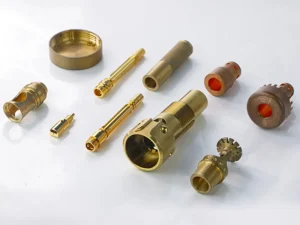
First of all, manufacturers decide on the materials. Remember, bronze comes in different types, and each has unique properties. They choose the type of bronze that offers the properties the manufacturer needs.
- Step 2: Process Selection
The second step is to use the right machining technique. It is noteworthy that bronze can be machined through different techniques. Each of them gives a unique output. For example, turning is used to make cylindrical bronze parts. On the other hand, milling is suitable for making flat or planar parts.
- Step 3: Material Loading
Once the material is selected, the next step is to load it onto the machines. Operators carefully load the material and clamp it. This ensures the workpiece does not move or vibrate during operation. In some cases, the workpiece rotates, so clamping it keeps it stable during movement.
- Step 4: Parameters and Machining
After loading the material, operators adjust the machine parameters. This includes speed, feed rate, cut depth, and more. These parameters are adjusted based on the machining process and requirements. Remember, wrong parameters will result in wrong cuts and imperfections. Once the parameters are set, the machines are activated and begin machining.
- Step 5: Post Processing
After machining, you’ll receive the cut and shaped bronze parts. However, these parts may not be perfect visually. Therefore, manufacturers use various post-processing steps to make it look good. These include deburring, polishing, coating, and more. This is the last step, and machined parts after post-processing are sent to the inspection team.
Types of Techniques Used in Bronze Machining
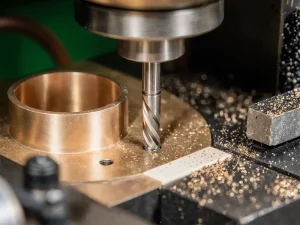
Machining bronze may sound straightforward, right? However, it is not as simple as it involves the use of different machines and techniques to make the final bronze parts. In the section below, I will discuss the most commonly used technique in bronze machining.
1- Milling
Milling operations involve the use of dedicated milling machines. The workpiece (bronze) is loaded onto the machines and remains stationary. The milling machines have cutters that move via a spindle. These cutters cut the stationary bronze and shape it as per the set instructions. Milling operations help produce complex-shaped bronze parts with exceptional precision. Using this process also helps achieve high tolerance during production. Major manufacturers use milling to create flat or plain surfaces on bronze.
2- Turning
Turning is another machining operation used for bronze. It is the opposite of milling in its mechanism. Unlike milling, turning involves the rotation of a workpiece mounted on a holder. The cutters remain stationary during the operations. The bronze is rotated and is cut and shaped by the stationary cutting tools. This process is more common when manufacturers need cylindrical bronze parts. In terms of precision, turning is no less precise than milling. Lathe machines are used for very precise turning.
3- Drilling
Drilling is another important machining process used for fabricating bronze. You will see holes in various metallic parts. The drilling technique makes these holes. This process involves the use of drill bits, which rotate towards materials and remove them. In this way, it creates holes of precise size. Remember, drill bits are available in various sizes and diameters suitable for making holes of different sizes. Drilling involves cutting to create holes in the material for nuts and bolts.
4- Grinding
Grinding is one of the most important machining operations used for surface finishing. As I said earlier, bronze is used to make bushings, bearings, and other parts that face friction. If their surfaces are smooth, these parts can perform better in frictional applications. Therefore, a grinder is used that consists of abrasive rollers or wheels. This wheel moves across the bronze surface, smoothing it. Almost all modern bronze parts undergo grinding. Not only surface finishing, but grinding also improves the overall look and feel of parts.
5- Boring & Reaming
Both boring and reaming are generally used after the drilling. As previously mentioned, drilling uses drill bits to create a hole. But these holes may not be accurate or may be smaller in diameter. The boring and reaming help make the holes more precise. Boring precisely removes small amounts of material and enlarges the hole drilled by the drill bit. On the other hand, reaming uses a reamer that has multiple edges. It also improves the quality of holes created by drill machines. Both ‘reaming’ and ‘boring’ are used in parts such as bearings, where hole precision and tolerance are most important.
6- Tapping & Threading
Tapping and threading techniques are used to create threads on bronze-made parts. These threads are crucial as they help two parts fit and fasten together securely. Tapping helps create a thread inside any part. On the flip side, threading is more common and is used to create threads on the external sides. These two processes can create threads of different sizes based on individual requirements. Remember, bronze is not very hard and rigid. As a result, these two techniques can easily create a thread with a tight tolerance.
7- CNC-Based Machining
This is probably one of the most popular terms used in modern industries. CNC technology incorporated into cutting machines makes them faster and more accurate. CNC machining is not a standalone operation. Instead, it refers to any machining procedure that uses CNC-based machines. These machines use computerised instructions for their operation. Not only are they fast, but they also offer tight tolerance even in making the most complex-shaped parts. CNC machining refers to the use of CNC machines. Similarly, the use of CNC lathes will lead to a CNC turning process.
Types of Bronze Used in Machining
Bronze is an alloy, meaning it consists of various alloying elements. There is no limit on the materials it can contain. However, those materials, with their different compositions, give rise to different types of bronze. Since they have different compositions, they differ in their properties and overall performance. Here is the list of some of the most common bronze types:
- Silicon Bronze
- Leaded Bronze
- Bearing Bronze
- Phosphor Bronze
- Aluminum Bronze
- Manganese Bronze
- Nickel Aluminum Bronze
All these types are based on different alloy elements. For example, silicon bronzes contain high levels of silicon along with copper, aluminium, and other elements. On the other hand, leaded bronze has lead along with other elements. Silicon bronze does not contain lead. Similarly, aluminium bronze has a high aluminium content, which gives it excellent corrosion resistance.
Interestingly, some of these bronze types are stronger and harder. They can withstand impact and harsh use with ease. However, their machining is difficult due to their higher hardness. On the other hand, some bronze types are softer and can be machined easily. Therefore, it is crucial to choose the type of bronze that best suits your requirements.
It is worth noting that all the types listed above can be machined, but their ease can vary. Remember, nickel-aluminium bronze and aluminium bronze are two different types. Regular aluminium bronze does not contain nickel, whereas nickel aluminium bronze does. As a result, nickel-aluminium bronze is stronger, tougher, and performs better than aluminium bronze.
Advantages of Bronze Machining
Undoubtedly, bronze is one of the most widely used materials for machining. It undergoes various machining procedures depending on the parts we need. Here are some key benefits which increase the value of bronze machining:
- Easy Machinability: First, bronze is not a very hard and rigid material. Instead, it is slightly softer, which allows cutters to cut it. This means the bronze machining is not very difficult and does not affect the machines.
- Corrosion-Resistant: As mentioned above, bronze has copper, which makes a copper oxide layer (patina). This layer acts as a barrier, protecting the material from corrosion. This material is machined to make various parts used in the marine industry.
- Excellent Strength: Despite not being too hard, bronze has excellent strength and toughness. This is because it contains tin and aluminium. Tin strengthens the patina layer, improving the overall durability of bronze.
- Thermal Conductivity: Bronze has a high thermal conductivity. When exposed to heat, it can conduct and disperse heat. Thus, it is not adversely affected by the heat produced during machining. As a result, the cutting tools cut it smoothly without heat buildup on the workpiece.
- Excellent Stability: During machining, bronze remains exceptionally stable. It does not warp, which is a significant advantage. This makes machining bronze much easier and less time-consuming. The cutting tools cut and shape it repeatedly without stopping. Even the heat generated by tools does not cause warping in this material.
- Cost-Effective: Bronze has a lustrous finish, largely due to patina layers. As a result, parts made from these materials look visually finished, largely due to the fact that they are not very expensive, which is a key highlight. This means manufacturers make this copper-based alloy and make products at very affordable prices.
Conclusion
In conclusion, bronze is a material with many advantageous properties. Parts made from this material last longer, perform better and are cost-effective. What makes bronze stand out is its easier machining. Because this material is not extremely rigid, cutting tools can easily cut and shape it.
Manufacturers across industries use it to produce a wide range of parts. However, this material has a drawback: it produces stringy chips during machining. So you should be ready to remove these chips so that they don’t get stuck in the cutting tools. In this article, I have discussed the basics of bronze machining, its process, technique and key benefits.